
Climate Action
JHU has ambitious targets to reduce greenhouse gas emissions and prepare for the impacts of climate change. To ensure we are working to support climate targets in the Maryland and D.C. region, JHU is continuing to advance decarbonization, energy efficiency, and climate adaptation efforts across our campuses.
GOAL 3. Boldly Act to Reduce Greenhouse Gas Emissions
JHU is committed to achieving net zero greenhouse gas (GHG) emissions by 2040, through a combination of building energy efficiency, renewable power, electrification, and other programs aimed at reducing emissions and use of fossil fuels.
Achieve net zero scope 1 and 2 greenhouse gas emissions by 2040
JHU's climate commitment aligns with local and global targets to reduce greenhouse gas emissions by mid-century in order to avoid the most harmful impacts of climate change.
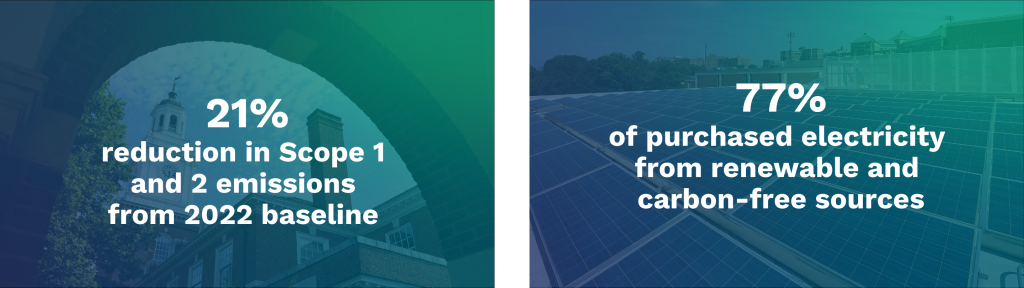
JHU's GHG emissions continue to decrease annually
Methodology: JHU’s GHG emissions inventory follows the Greenhouse Gas Protocol, the global standard for emissions accounting and reporting. JHU’s emissions inventory has been independently verified since 2022 and is reported publicly through The Climate Registry.
Notes:
- JHU’s 2025 51% GHG reduction goal was met three years early in 2022. Since 2008, GHG emissions have decreased 60%.
- In 2022, JHU’s GHG methodology was updated to include leased buildings, and a new baseline was established.
- In 2024, JHU transitioned to calendar year GHG reporting to align with reporting requirements to the state of MD. All years prior to 2024 indicate fiscal year data.
- In 2024, emissions continued to decrease partially due to the interruption in the use of cogeneration at the Homewood Campus and overlapping contracts for renewable and carbon-free energy.
77% of purchased electricity was from renewable and carbon-free sources
Methodology: Electricity from renewable and carbon-free sources was divided by total electricity use to obtain each percentage.
Notes:
- “Purchased electricity” refers to electricity purchased from the grid or through contractual power agreements, as opposed to electricity produced using on-site power plants.
- JHU’s percentage of purchased electricity was slightly higher than usual due to overlapping contracts for renewable and carbon-free energy.

A near-term priority for JHU campuses is to develop decarbonization master plans and study the feasibility and phasing of solutions to achieve JHU’s climate goals.
- The decarbonization planning process at the Applied Physics Laboratory (APL) is underway, with a first analysis finalized in May 2025
- Other campuses are developing scopes of work and identify vendors to support planning efforts
JHU initiated the assessment of additional renewable and carbon-free energy options to determine pathways for achieving 100% clean power by 2030.
- APL entered into a new electricity contract allowing them to procure 100% hourly-matching carbon-free energy, ensuring their energy is zero emissions at time of use
JHU published its third verified annual GHG inventory.
- JHU obtained the “Champion” recognition from The Climate Registry (TCR), highlighting the university’s commitment to transparent and accurate reporting of emissions, as well as ambitious climate goals
- Only 16 universities across the U.S. have their emissions validated as TCR members
Accelerate decarbonization and energy efficiency in existing buildings
Reducing overall energy consumption is a key piece of achieving JHU's climate commitments, in addition to eliminating GHG emissions
Energy Use Intensity (EUI) remained stable despite growth in JHU's building area
Methodology: EUI was calculated by dividing total building energy use by total gross floor area.
Note: Data points in parentheses show percent change from 2022.

JHU divisions are prioritizing energy efficiency to meet JHU’s climate commitment as well as the State of Maryland’s Building Energy Performance Standards:
- APL created a new Energy and Sustainability Section as part of its broader Facilities Maintenance and Operations Group, creating a deeper focus on their existing efforts.
- This new section will focus on reducing electricity and natural gas use 10% via efficiency improvements during the first year
- Operations teams at the Bloomberg School of Public Health are implementing a strategy which includes:
- Enhancing building automation systems for improved system control and fault detection
- Conducting existing building commissioning
- Completing energy efficiency upgrades to lighting and HVAC systems

JHU’s Green Labs Program continued to expand, engaging more lab users across schools and divisions through new and continuing initiatives.
- Johns Hopkins saw its highest participation in the International Freezer Challenge, with a 36% increase in represented labs. Saving an estimated 1,550 kWh/day, JHU won the award for Top Academic Institution, besting over 110 institutions competing globally. The GI Oncology Lab and the Quinn-Tobian La were global-level winners.

Freezer Challenge participants at awards luncheon. - 15 labs completed their My Green Lab Certification, and 3 labs completed recertification
- The inaugural Green Labs Vendor Fair connected more than 200 faculty, students, and staff researchers with over 20 vendors offerings sustainable alternatives to research supplies
- The Office of Climate and Sustainability (OCS) and the Chemistry Student Safety Committee hosted the first Shut the Sash competition in the Krieger School of Arts and Sciences Chemistry Department, which aimed at changing lab user behavior, reducing energy, and improving safety by closing fume hood sashes
Establish a scope 3 greenhouse gas emissions reduction initiative
JHU is committed to analyzing and developing a scope 3 GHG emissions reduction initiative, addressing categories of emissions from the university's value chain.

JHU’s new electric buses will reduce emissions from employee and student commuting

Scope 3 emissions estimates have been analyzed for several categories:
- Emissions from student and employee commuting were computed for 2022 and 2024 using data from the biennial JHU Transportation Survey
- The Travel Emissions Dashboard, a project of the Campus as a Living Lab program, was designed to show university air travel emissions estimates from fiscal years 2018-2024

Screenshot from JHU’s Travel Emissions Dashboard - Hopkins Dining is a member of the Menus of Change University Research Collaborative, which provides a yearly estimate of emissions from Hopkins Dining food purchases
GOAL 4. Prepare Our Campuses and Communities for Future Climate Conditions
JHU developed and adopted the High-Performance and Healthy Buildings (HPHB) Requirements, addressing holistic sustainability criteria across design and construction projects. As a part of the program, new construction and major renovation projects must assess climate change impacts and integrate adaptation measures into all projects. University researchers are also working to expand partnerships aimed at advancing equitable climate adaptation in Baltimore and beyond.
Integrate climate change impacts and adaptation strategies into campus plans and policies
In addition to mitigating JHU's impact on climate change, the university will focus on adaptation and resilience measures to prepare for future climate conditions.
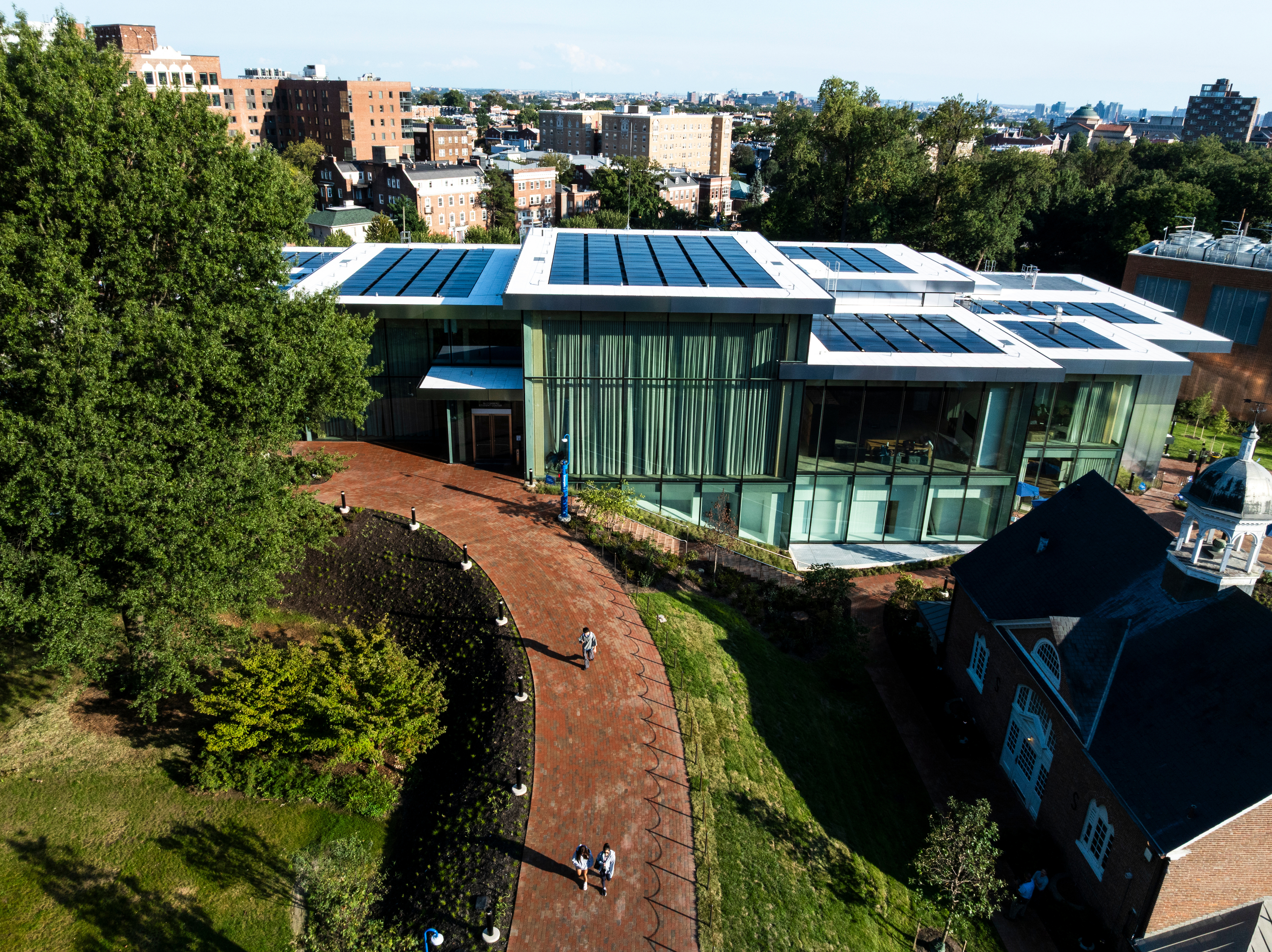
Aerial view of the new Bloomberg Student Center, which has an underground cistern to capture increased rainwater runoff for toilet flushing and irrigation.

Climate adaptation measures have been integrated into JHU’s HPHB Requirements.
- New construction and major renovation projects must conduct a climate risk assessment to evaluate the impacts of extreme heat, poor air quality, flooding, and storms based on future weather models
- Projects are required to implement adaptation measures for topics such as heat island reduction, enhanced indoor air quality, and rainwater management
- Several projects have implemented adaptation measures, such as the Bloomberg Student Center and Data Sciences and Artificial Intelligence Institute, which have installed stormwater cisterns to manage larger amounts of rainfall due to increased storm intensity
Partner to advance equitable climate adaptation in Baltimore and beyond
JHU researchers are partnering with local communities to assess changing regional weather patterns and inform climate adaptation solutions.

BSEC’s Ben Zaitchik discusses community weather stations with participants of a field visit to Baltimore’s Old Goucher and Broadway East neighborhoods. Credit: Aman Azhar/Inside Climate News.

Working with businesses, local and state government representatives, and community organizations, Baltimore Social-Environmental Collaborative (BSEC) scientists produce the decision-relevant science needed to address local priorities and needs.
- BSEC research teams studied air pollution, extreme heat, and vegetation datasets collected in collaboration with Equitable Pathways Steering Committee members and other community organizations
- BSEC’s network of 50+ community weather stations has continued to provide critical data on neighborhood-scale weather variability in Baltimore, including during extreme events
- Work was done to customize advanced building energy models for Baltimore rowhomes, which yielded important results on heat risk and energy burden associated with unimproved and retrofit rowhomes under different microclimate conditions and future weather scenarios
- BSEC continues to work to characterize and map methane hotspots across the city, an issue that is of considerable stakeholder interest because leaky natural gas infrastructure is likely the leading source of elevated methane concentrations
- CoURAGE, the intensive atmospheric measurement campaign that is a sister project to BSEC, got underway in December 2024

Explore More About Climate Action at JHU
Learn more about the university’s commitments in our Climate Action and Sustainability Plan.