
Built & Natural Environments
JHU is committed to planning, designing, and operating buildings that promote efficiency and healthy indoor environments. At the same time, the university is also enhancing greenspace to provide quality access to nature, while protecting biodiversity, and strengthening community connections.
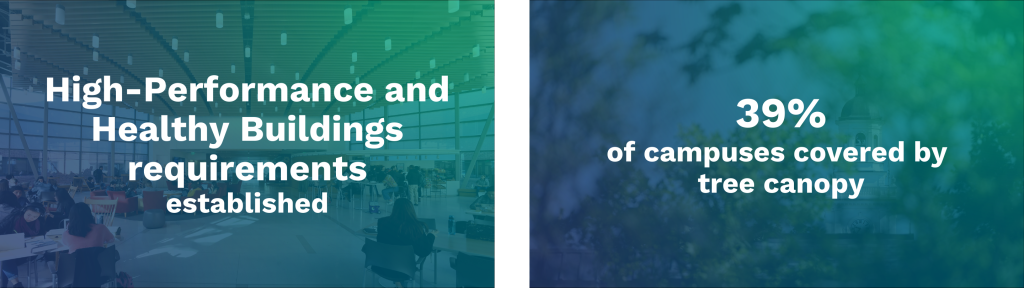
GOAL 5. Plan, Design, and Operate Buildings and Campuses to Safeguard Environmental and Human Health
JHU has made strides in advancing sustainability in the built environment through the endorsement of holistic High-Performance and Healthy Buildings (HPHB) Requirements and the development of policies that promote an efficient use of space when designing workspaces and classrooms.
Embed sustainability and health into all campus planning
Campus planning outlines the long-term direction of a higher education institution’s physical and built environment, and is the best scale at which to address many facets of sustainability, including decarbonization, climate adaptation, and transportation.
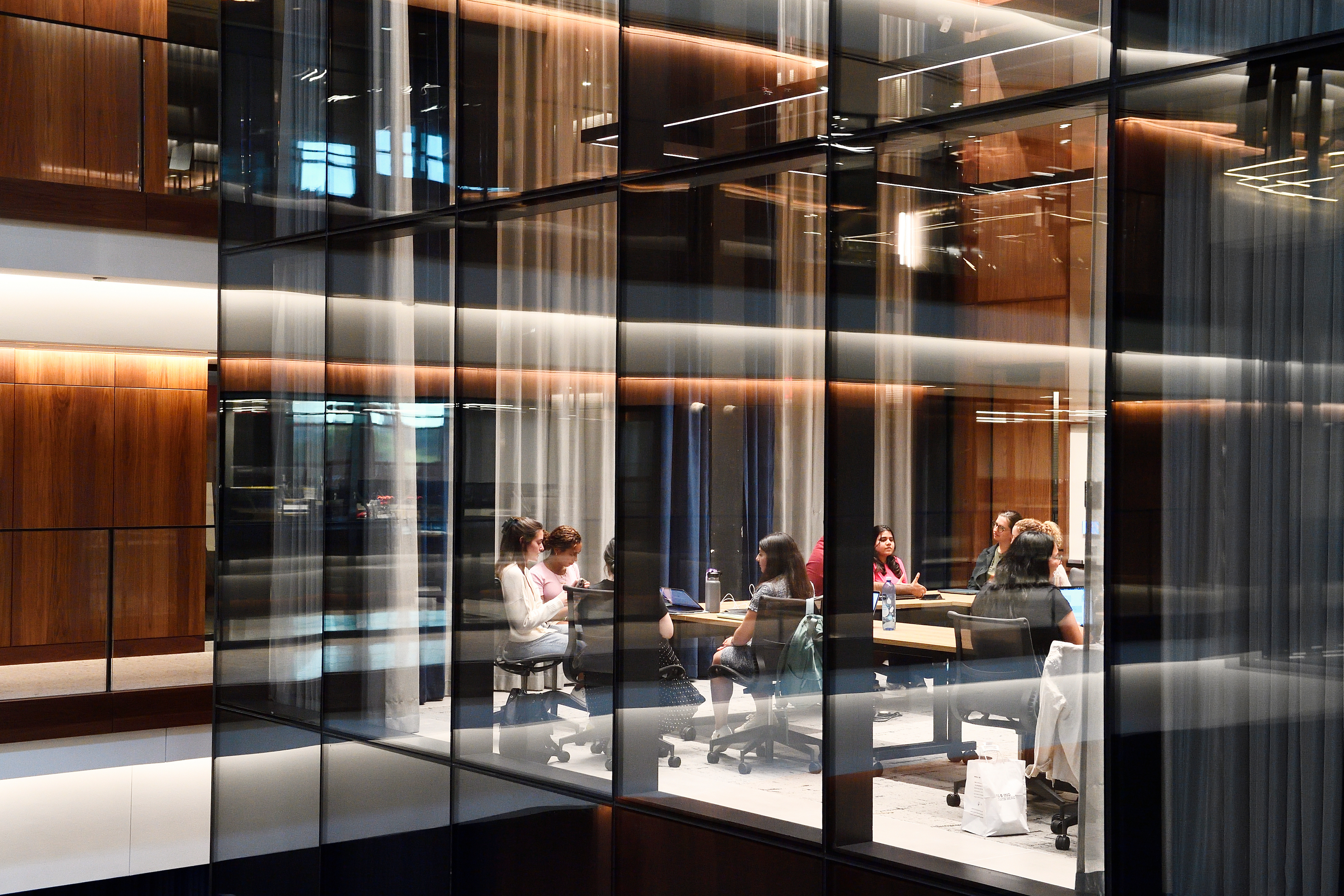
Hopkins Bloomberg Center, a 435,000 sqft LEED Gold building in Washington, D.C.

JHU developed policies to improve space utilization in new and existing buildings that can maximize occupancy and efficiency, support occupant well-being, and reduce pressure on land development.
- JHU’s Workplace Guidelines establish practices for the design of offices, workstations, support spaces, and amenities
- As offices are one of the largest space uses at JHU, the guidelines will have significant impact in realizing the university’s climate and sustainability goals
- Current new construction and major renovation projects at Homewood and East Baltimore have been designed in alignment with these guidelines
- Learning Environment Guidelines were also developed alongside the design of multiple classroom renovations in Shaffer and Remsen Halls, which served as test cases
- The guidelines establish ideal and baseline configurations and performance criteria for classroom renovation projects to create spaces that support teaching and learning, student success, and occupant well-being
- Providing Supportive Environments was a key pillar of the Guidelines, prioritizing views to the outdoors and natural light, ergonomics, temperature control, appropriate lighting, and durability and sustainability of material selections
- All Registrar-managed classrooms on the Homewood campus will be required to comply with the guidelines, and the document will be a resource for divisions and other campuses
Design and operate buildings to reduce emissions and provide healthy environments in which to work, learn, and thrive
JHU has created green building standards that will embed sustainability through all stages of every project across the institution, enhance positive outcomes for occupants and the environment, and reduce cost premiums associated with sustainability measures.
19 JHU buildings are currently LEED certified
Methodology: U.S. Green Building Council database with input from JHU facilities teams
Notes:
- LEED is a leading global rating system for building sustainability
- JHU has 19 LEED-certified buildings: 9 Silver, 9 Gold, and 1 Platinum; 9 of those are LEED BD+C (Building Design and Construction), and 10 are LEED ID+C (Interior Design and Construction)

JHU’s HPHB Requirements were developed to meet the university’s sustainability, health, and well-being goals for new construction and major renovation projects.
- The HPHB Requirements were endorsed in Spring of 2024 and have been implemented on a number of new construction, major renovation, and modification projects since then.
- The Early Learning Center was the first new construction project, resulting in a highly energy-efficient building and more than 53% energy savings compared to a code-compliant building
- The Milton S. Eisenhower Library was the first major renovation project to implement the requirements, focusing on improving indoor air quality and connecting to the Homewood Power Plant through an efficient hot water loop
- The HPHB Requirements establish a LEED Gold minimum requirement.
- LEED is a globally recognized third-party framework, developed by the U.S. Green Building Council, which certifies buildings on a range of holistic sustainability criteria
- While JHU has been using LEED since its inception in 1998, systematizing its use will ensure all buildings meet similar levels of environmental benefits and occupant comfort
- A working group of JHU facilities staff developed a set of tools to support the implementation of the HPHB Requirements, including a compliance checklist and a life cycle cost analysis tool to compare the cost of different design strategies over the life cycle of the building.

Divisions have also focused on reducing the environmental impact of maintaining their buildings by adopting green cleaning practices:
- APL switched to an aqueous ozone solution, which is expected to reduce chemical cleaning purchases by 70% to 80%
- The Bloomberg School of Public Health obtained Green Seal Certification, an industry-leading certification for green cleaning, by adopting new cleaning products and procedures that meet a high benchmark of safety, efficacy, and occupant health
- Homewood implemented a Green Cleaning Building Policy which focuses on the use of cleaning products that are non-hazardous and biodegradable
Align our leased spaces with climate and sustainability goals
JHU is the landlord or tenant of many leased spaces throughout the Maryland and DC Region. Adopting practices such as green leasing can help address climate change, promote energy efficiency and cost savings, and improve occupant health, comfort and productivity.
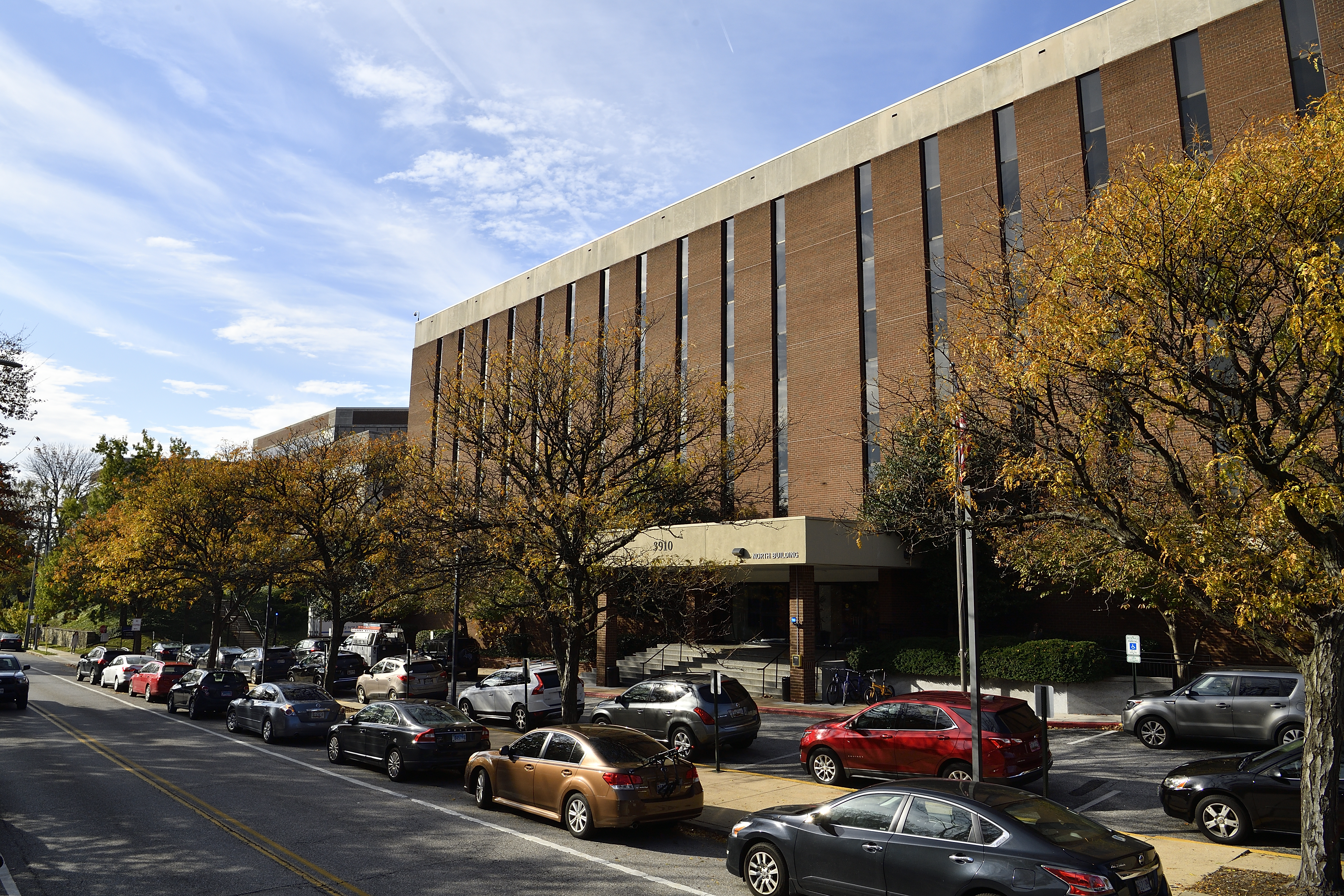
Exterior of the Keswick Building.
Buildings owned by third-parties and leased to JHU have been included in the university’s greenhouse gas inventory since 2022, representing about 200 buildings, over 2.5M sq ft, and 13% of JHU’s total emissions in 2024.
GOAL 6: Design and Steward Landscapes That Enhance Biodiversity, Health, and Community Connections
JHU’s landscapes are an essential part of our campus identities. They play a critical role in offering space for recreation, while improving well-being and enhancing ecosystem services. By using our landscapes as living laboratories for teaching and research, the university is committed to fostering solutions that improve biodiversity and ecosystem health.
All campuses have accessible greenspace to enhance biodiversity, support well-being, and increase climate resilience
JHU is committed to commit to improving and expanding access to greenspace that supports the surrounding regional ecosystems.
39% of JHU’s campuses are covered by tree canopy
Methodology: Aerial imaging using Nearmap software
Note: Click on a circle to display the campus name and canopy area details

JHU has improved its knowledge and tracking of its tree inventory and canopy to be able to measure progress:
- A Homewood Campus tree inventory and GIS map were completed, improving data and recordkeeping on the university’s tree species and canopy.
- The Office of Climate and Sustainability partnered with JHFRE Information Services to use Nearmap, an aerial imagery software, to calculate detailed tree canopy area for all campuses – allowing JHU to measure growth in tree canopy coverage over time.

3 Campus as a Living Lab projects leveraged Homewood Campus grounds to explore sustainability innovations, including:
- Environmental Health and Engineering research project to measure the stormwater management efficacy of the water retention basin at Olin Pond
- Whiting School of Engineering course on maximizing rainwater storage for irrigation
- Department of Earth and Planetary Sciences course on forested ecosystems

2 vegetable gardens are currently active at JHU and open to the local community:
- The Blue Jay’s Perch community garden located at Eastern Campus
- A raised bed garden on the Homewood Campus Wyman parcel

Blue Jay’s Perch.
Protect local water resources through conservation and stormwater management best practices
JHU plans to continue improving water conservation and stormwater management efforts across all its campuses.
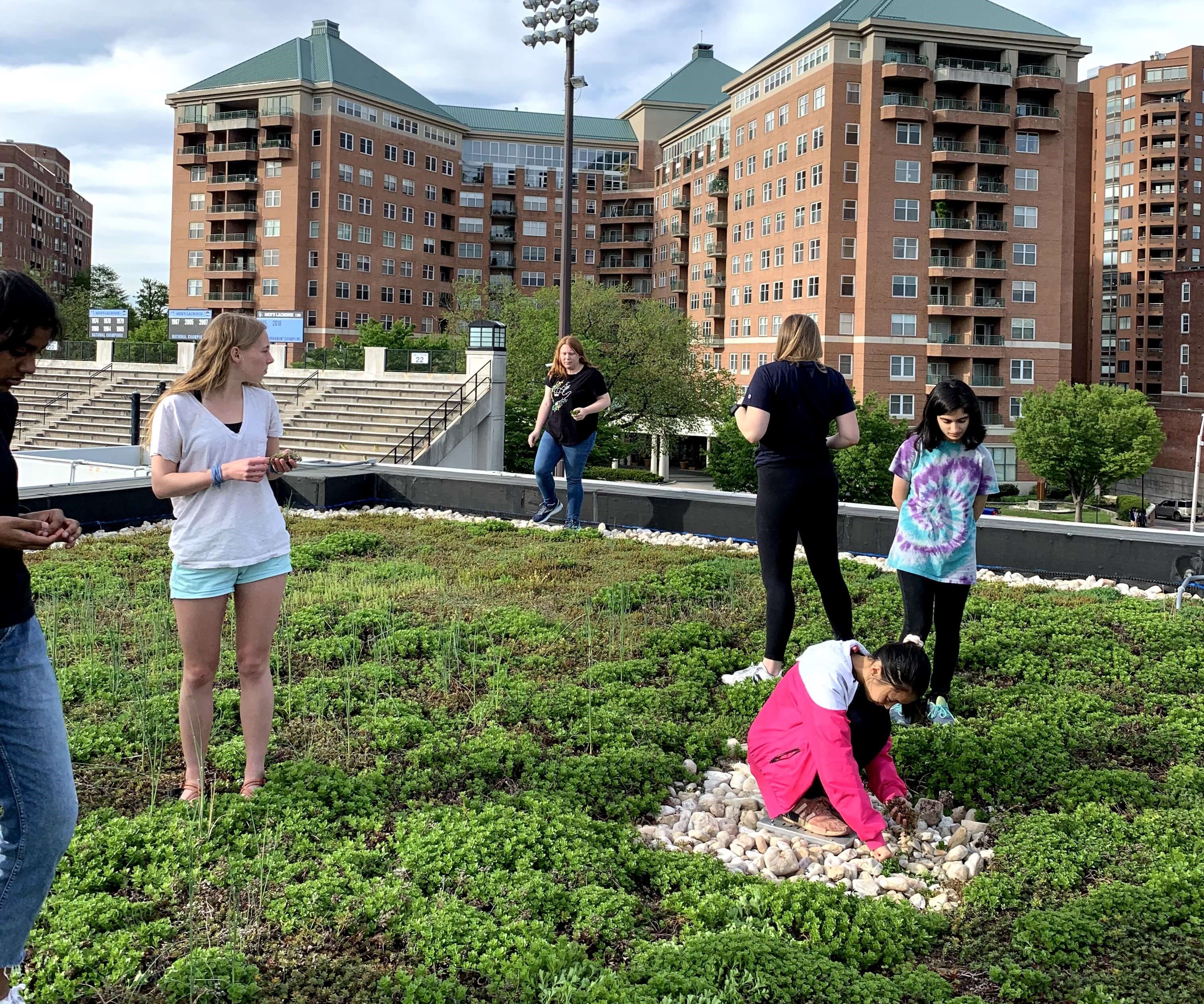
Green roof on the Cordish Lacrosse Center.

JHU’s HPHB Requirements necessitate teams to enhance stormwater management on their project site, accounting for increased storm intensity in future climate models, allowing JHU to assess, adapt, and better manage climate-related risks.
Related Links
Explore More About Built & Natural Environments at JHU
Learn more about the university’s commitments in our Climate Action and Sustainability Plan.