Diana Murtaugh is an undergraduate junior majoring in Earth and Planetary Sciences (EPS) and English at the JHU Krieger School of Arts and Sciences. She conducts undergraduate research in Dr. Daniel Viete’s Tectonics, Metamorphic Petrology, and Orogenesis (TeMPO) Lab. Her project on the geologic formation of the Northern Appalachian Mountains will become her senior honors thesis.
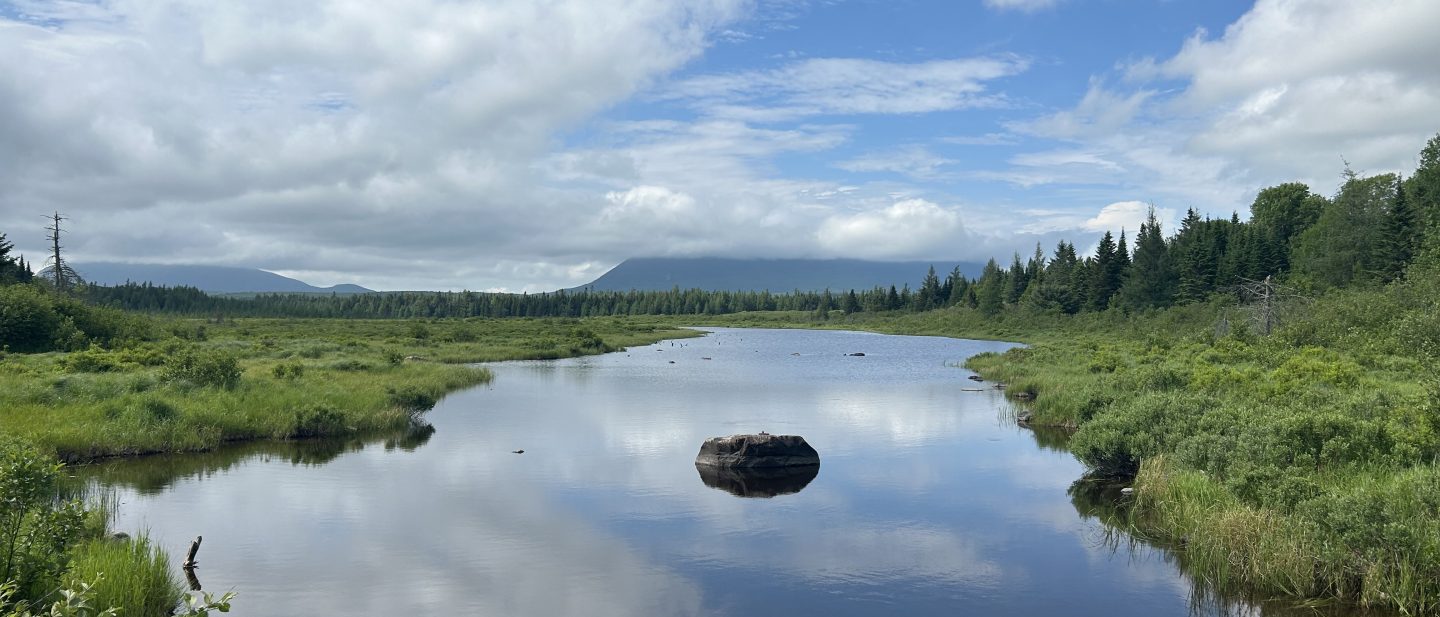
Murtaugh joined the TeMPO Lab in the spring of her freshman year and has worked alongside graduate student mentor Supratik Roy since. She has accompanied Roy for two summers of field work in Maine, where he studies metamorphism in the Appalachians (metamorphism: changes in the mineral and structural makeup of rocks due to pressure, temperatures, and chemical environments different from those under which the rock originally formed). Murtaugh’s independent project grew out of an interest in the connection between igneous rocks (formed by the cooling and solidification of magma or lava) and the metamorphism that Roy studies in the region. She studies the relative timing and formation environments of plutons (igneous rock units) to see how such factors determine extension and collision during the formation of supercontinents and mountain belts.
We sat down with Murtaugh to learn more about her research experience and the importance of environmental research:
How have your research experiences contributed to your educational and overall experience at JHU?
During her freshman fall, Murtaugh took the introductory geology course “Dynamic Earth” with Dr. Viete and Dr. Kevin Lewis. She became interested in the history of earth and plate tectonics, so contacted Dr. Viete to get involved with his lab.
“Research has become the thing that really motivates me,” says Murtaugh. “It’s made me really passionate about this field.”
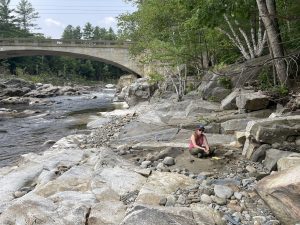
Murtaugh expressed gratitude for the opportunity to conduct her field work in Maine, to collect rock samples herself, to process samples in the lab, and to ultimately match dates to rocks. She values hands-on experience and the ability to complete, firsthand, the entire process of dating a rock, from sampling to final processing.
“I appreciated being able to get involved in research so early at Hopkins,” says Murtaugh. “I have already had two and a half years to actually work on this project.”
Her coursework informs her research, as well. Murtaugh is currently taking a course about geochronology, titled “Rocks as Clocks,” with Dr. Viete. The coursework, she says, is directly applicable to her research.
“Research has become the thing that really motivates me,” says Murtaugh. “It’s made me really passionate about this field.”
Murtaugh values the interdisciplinary nature of the EPS department. She highlights the course “Introduction to Global Environmental Change,” taught by Dr. Anand Gnanadesikan and Dr. Ben Zaitchik, which explores a range of earth systems across multiple disciplines. The course is not strictly geology-focused, but is relevant to geology and has helped Murtaugh in other courses, where she can apply certain learned concepts to earth history and stable isotope systems.
“You get exposed to a lot of research outside of what you are specifically focused on [in the EPS department],” she says. “Because the earth is one system, it all ties in together.”
How could your research contribute to a more sustainable future?
“People don’t think about it a lot, but plate tectonics have a big influence on how our climate works on really long time scales,” says Murtaugh. “Understanding the details of how each system and mountain belt forms is important for understanding the geodynamics of subduction and how that influences climate.”
Beyond this, the areas that Murtaugh studies are host to the formation of many critical minerals.
Critical minerals form, she says, in subduction environments where there is a lot of influence from the deep earth.
“Understanding how those kinds of environments form is really important for understanding where we are going to find critical minerals, which are important for the Green Energy Transition,” she says.
Why is environmental research important? Especially for undergraduates?
“I think a lot of the issue right now with people not believing in climate change is that they don’t understand the science,” says Murtaugh. “Getting involved with environmental and geoscience research and getting first-hand experience lets you understand how the scientific process works.”
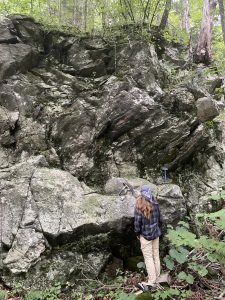
Research, she says, allows us to understand how earth systems work, what changes we need to make in the face of climate change, and how such changes might affect the earth and its climate in the future. That is why Murtaugh is drawn to earth science research in particular. She values the ability to study events that happened in the past, their effects, and learn what changes are necessary in order to prevent similar events from happening in the future.
“Getting involved with environmental and geoscience research and getting first-hand experience lets you understand how the scientific process works.”
Beyond this, Murtaugh emphasizes the importance of being able to get hands-on experience and understand how hard it is to actually conduct research. Without this experience, it is difficult to appreciate just how much time and energy the research process takes.
“I have been working on some rock samples for a year and a half and I still don’t have a date on them yet,” she says. “It takes a lot of time to get that one data point.”
By conducting her own research and getting exposed to other work in the EPS department, Murtaugh has developed an appreciation and respect for the research process and its unique demands.