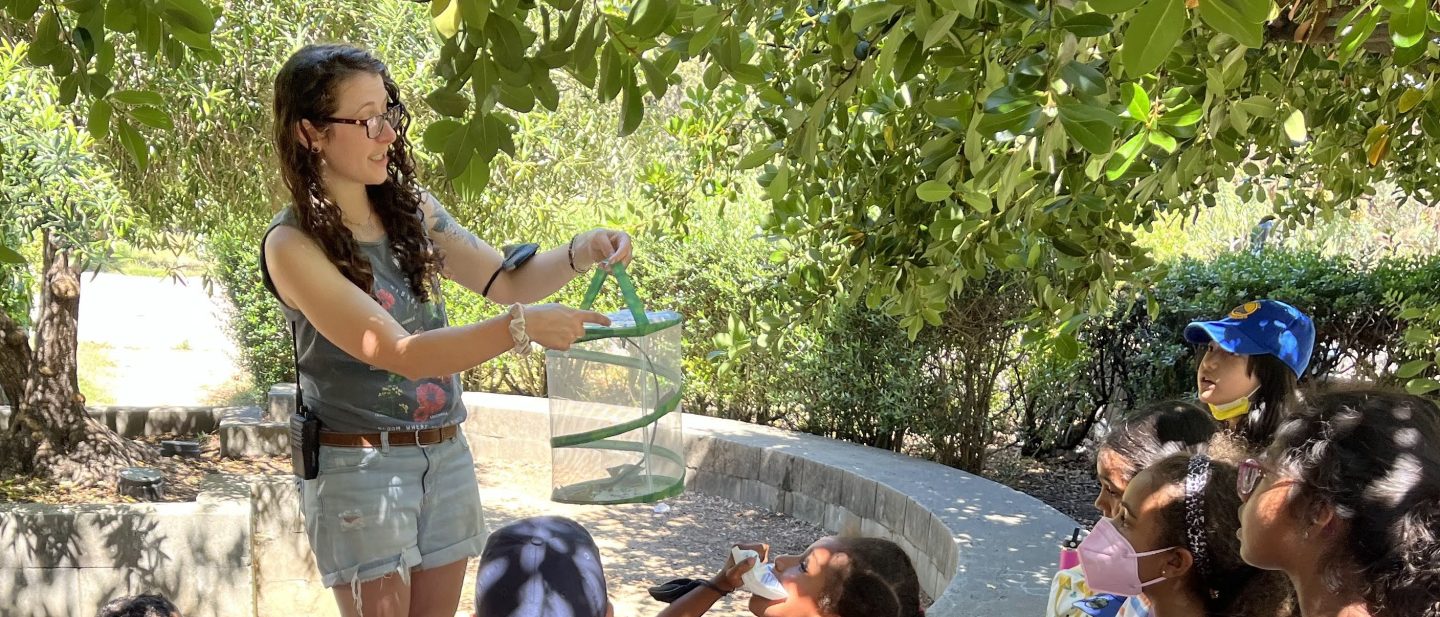
Lindi Shepard is a doctoral candidate at the Johns Hopkins School of Education. In the Social Psychology in Education and the Environment Lab (SPiEE), Shepard studies how social psychology mechanisms can impact the way people think about environmental issues. She is curious about how humans develop socioecological consciousness— how we understand our roles in our environmental communities. Shepard is advised by Dr. Alexandra Shelton and Dr. Hunter Gehlbach.
As a former teacher, Shepard is interested in understanding how people learn and teach about the natural world, and how teachers can collaborate with nature as a co-teacher. Shepard is curious about how to provide teachers with the tools they need to teach about environmental issues like climate change, sustainability, and biodiversity. How can teachers incorporate local ecosystems into their lessons? How can lessons involve real world practices and applications? Shepard’s work explores these questions.
We sat down with Shepard to learn more about her research:
What led you to pursue this work?
“First, I love spending time in nature– it’s something that really fills my cup,” says Shepard.
Her childhood, spent outdoors in the wetlands of New Jersey, inspired a love for the natural world.
When Shepard began her career as a special education teacher in preschool and early elementary classrooms, this love for nature became central to her teaching philosophy. She largely worked in “full inclusion” classroom environments, wherein students with and without diagnosed disabilities all learn in the same setting together.
I noticed that in the garden every student could find something that got them excited, sparked their curiosity, or held their attention.”
“[In this type of classroom] you have a really wide range of abilities, interests, and different kinds of constraints– whether those be physical mobility constraints or different goals that the students are working on,” says Shepard. “This really challenged me.”
To confront this challenge, Shepard shared her love for the outdoors with her students – taking them on nature walks and introducing them to gardening. At each school that she worked in, whether in New York City or a rural town, she started a school garden.

“[Although] we had this huge range of abilities, I noticed that in the garden every student could find something that got them excited, sparked their curiosity, or held their attention,” says Shepard.
So, Shepard brought her lessons outdoors. Her students practiced math and literacy in the garden, but were also given the space to take interest in the flowers or put their hands in the mud.
“[Students] were all connecting in a serious way, but in different ways,” says Shepard. “It was a way to naturally differentiate my lesson so that I could reach all of my learners where they were at.”
Soon, fellow teachers began to ask Shepard about her outdoor lessons, so she wrote curricula. She enjoyed connecting with teachers and learning about what their goals for their students were.
As Shepard developed curricula, she grew curious about how and why outdoor educational experiences were so powerful. What was going on in students’ brains, she wondered, as they learned and observed outdoors?
“We are seeing a lot of benefits of spending time in nature,” says Shepard. “But I think we are just at the tip of the iceberg in understanding the different ways we benefit from spending time in nature.”
“I felt like I didn’t have the tools to understand what was going on,” says Shepard. “That’s what inspired me to go back to school.”
What are the impacts of nature-based education?
“Even in city environments, there are many opportunities for children and adults to experience the outdoors in different ways, whether that is through our thriving parks system or a [single] street tree,” says Shepard.
“There are some myths surrounding outdoor education,” says Shepard. Teachers often associate a lack of walls with a lack of control, she says. Such myths can be busted, however, through research, support for educators, and proof of the benefits of outdoor education.
That said, nature-based learning can happen in the classroom, too.
Whether or not teachers think that they are teaching students about the natural world or the environment, they are.”
In a traditional classroom, there are many ways to explore how humans are connected to the natural world, whether that be through lessons on the human body or by teaching students about the waste practices used in their school. Shepard emphasizes the importance of questioning the idea that humans are separate from nature.
“Whether or not teachers think that they are teaching students about the natural world or the environment, they are,” says Shepard. “Kids are always learning about how we think about nature and the environment.”
Because of this, Shepard says that the ways teachers talk about nature matter.
“In the stories that we read in classes, we [might] talk about animals as something to be controlled or purchased or owned or caged,” says Shepard. “In a math lesson, it is a given that everyone is driving their own car or that someone is selling plastic water bottles at a soccer game.”
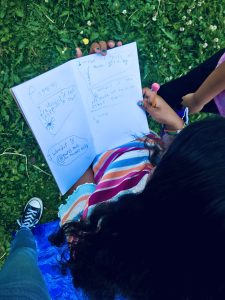
Such language that teachers use in lessons influences the way students perceive the natural world and their role in the cycle of consumption and waste production.
“How might we shift the language that we use to [reference more] sustainable practices?” asks Shepard. “What can we do to prepare teachers to interrogate the structures that are there and think about the ways that they refer to the natural world?”
“It’s not that teachers don’t want to do this work,” says Shepard. “They are excited when they hear about it and especially if they experience it themselves, but it’s not something that is commonly threaded through the curricula.”
Right now, says Shepard, it is the responsibility of the teachers themselves to “do the leg work” if they want to adopt a nature-based curriculum. Shepard wants to help change this.
“[Teachers] already have a lot of demands on them,” she says. “They shouldn’t have to reinvent the wheel just to bring this to their students.”
What are the greater implications of your research? How could your findings contribute to a more sustainable future?
“I want teachers to feel empowered to bring this work into the classroom,” says Shepard.
Teachers often feel the need to justify lessons in terms of learning gains in subjects like reading, math, or science, Shepard says. All of those can be taught, she says, through place-based and nature-based education. Examining the local watershed in Baltimore, for example, offers an opportunity to learn about local history, soil science, and chemistry – a number of traditional subjects with a much deeper connection to the surrounding environment.
“There are so many learning opportunities to engage with if we bring elements of nature-based learning into the classroom,” says Shepard. “It’s our job to show teachers that that possibility exists, and also make it easy for them to do it.”
Is there a lot of work being done in the field of nature-based education?
Shepard was specifically drawn to the Johns Hopkins School of Education because there are many researchers working in the field of nature-based and environmental education– especially her colleagues in the SPiEE Lab.
Hopkins has a thriving sustainability community and a thriving Planetary Health community.”
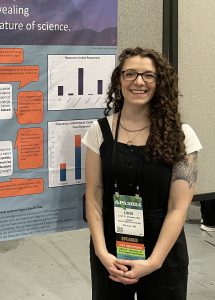
“I have been lucky that in my tenure here at Hopkins, there has been a lot of movement around incorporating Planetary Health as a major theme,” says Shepard. “The Institute for Planetary Health has been really great about uplifting educators and [their] work, and [recognizing] how important [education] is to the process of developing healthy communities and behaviors.”
“This work is not centered in many places, but I do feel like Hopkins has a thriving sustainability community and a thriving Planetary Health community,” says Shepard. “There are a lot of researchers here that are working towards ecological care.”
Shepard is a graduate fellow at the Ecological Design Collective, as well.
“I think about ecological issues through more of an education perspective in my research roles,” she says. “At the EDC, I get to think about how different individuals or disciplines are addressing this issue in really creative, innovative ways.”
“It’s all about connections and building a strong and thriving community of people who are thinking through these bigger socioecological issues,” says Shepard.
————————————————
KSAS undergraduates can register now for Shepard’s course “Thinking with Nature” (KSAS.AS.360.111(07)) that runs from March to April 2026.
“This course considers how cultivating sustained, mindful presence with the natural world represents a radical act amid the digital landscape of the attention economy.”